




.svg)
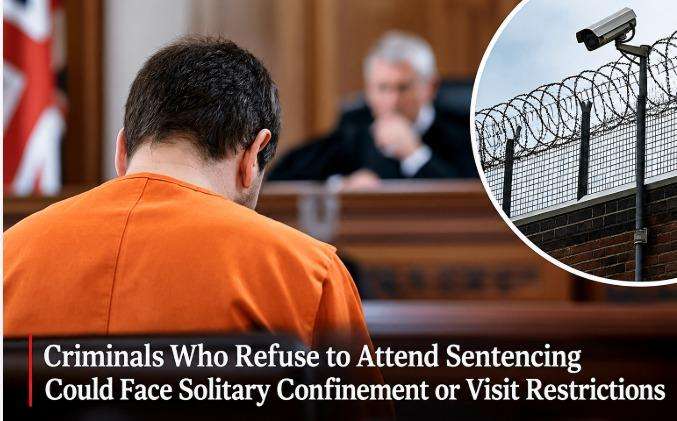
Judges in England and Wales are set to receive stronger powers to punish convicted offenders who refuse to attend their sentencing hearings, including restrictions on prison visits and confinement to their cells for up to three weeks.
The measures, expected to take effect next year, aim to ensure offenders face the consequences of their crimes in court, particularly when their absence prevents victims’ families from seeing justice delivered in person.
UK Investigates Potential Cybersecurity Risks After Critical PHP Flaws Trigger Global Alert
Under the proposed changes, judges will be able to impose additional prison restrictions on offenders who deliberately refuse to attend sentencing. The measures build on existing legislation that allows courts to order attendance and impose a fine or a further prison term of up to two years for contempt of court.
The new powers would allow offenders to be confined to their cells for up to three weeks. Social visits could be suspended for nearly a month, while other prison privileges could be withdrawn for longer periods.
Judges would also be able to restrict social visits to once every four weeks for almost three months in certain cases. For offenders aged 18 to 20, similar sanctions would apply for shorter periods.
Visits from prisoners’ children would be exempt from the new restrictions, according to the Ministry of Justice (MoJ).
The government has acknowledged that extending prison sentences alone may not deter offenders who are already serving lengthy terms. The new approach is intended to introduce additional consequences for refusing to appear before a court at sentencing.
Prisons Minister Catherine McKinnell said offenders should not be allowed to decide whether they face the court when their punishment is announced.
She said refusing to attend sentencing was an insult to victims and their families, adding that offenders must face consequences for their actions.
The announcement follows campaigning by relatives of several victims whose killers refused to attend their sentencing hearings.
The families of murdered schoolteacher Sabina Nessa, law graduate Zara Aleena and mother-of-three Jan Mustafa have previously called for changes to the law.
Thomas Cashman, who murdered nine-year-old Olivia Pratt-Korbel, and Kyle Clifford, convicted in a separate triple-killing case involving a crossbow and knife, also refused to attend their sentencing hearings.
The cases have renewed debate about how courts can ensure offenders face the consequences of their crimes while giving victims’ relatives an opportunity to witness sentencing proceedings.
Claire Waxman, the Victims’ Commissioner for England and Wales, said the announcement followed sustained efforts by victims’ families to prevent offenders from avoiding sentencing hearings.
She said consistent use of the new powers by courts and prisons would be essential to ensure families receive the accountability they deserve.
However, the proposed sanctions have also prompted concerns about their effectiveness and their potential impact on prisoners’ families.
Pia Sinha, chief executive of the Prison Reform Trust, called for evidence that the measures would increase attendance at sentencing hearings.
She also warned that restrictions on prison visits could affect relatives who had committed no offence themselves.
The debate highlights the challenge of balancing accountability for convicted offenders with the welfare of family members, including children, who may be affected by additional prison restrictions.
The new measures are expected to come into effect next year. Their practical impact will depend on how the powers are applied by judges and prison authorities.
The government says the changes are intended to reinforce the principle that convicted offenders cannot simply opt out of facing sentencing. Campaigners for victims’ families have welcomed efforts to address the issue, while prison reform advocates have called for evidence that the restrictions will achieve their intended purpose.