





.svg)
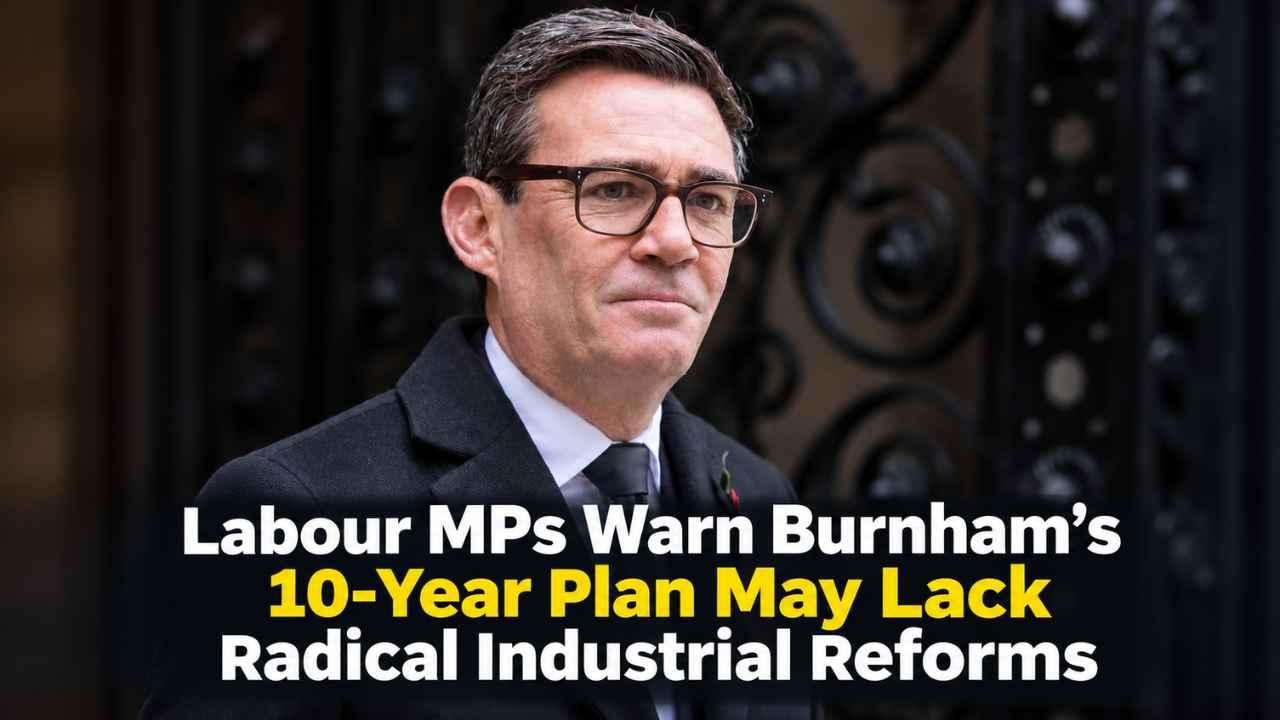
Labour MPs have raised concerns that Andy Burnham’s proposed 10-year government plan may not deliver the radical reforms needed to revive Britain’s industrial sector, warning that the country risks continuing to experience deindustrialisation without stronger government action.
Members of the Reindustrialisation Research Group (ReRG), including MPs representing former industrial areas in northern England, are due to meet Cabinet Office minister Sally Jameson on Wednesday, 11 November 2026, to discuss their concerns about the prime minister’s long-term strategy.
The group says the government must move beyond political promises and introduce practical measures to support manufacturing businesses, particularly those struggling with high energy costs and what MPs describe as insufficient government assistance.
The concerns come as expectations grow around Burnham’s 10-year plan, which he has presented as a defining blueprint for his ambitions for the country.
Andy MacNae, head of the Reindustrialisation Research Group, said the government's current strategy contained significant gaps that needed to be addressed through the proposed plan.
He said ministers had engaged with the group but argued that recent briefings had not provided enough evidence of a sufficiently ambitious approach.
“There are a lot of gaps in the government’s reindustrialisation strategy which are not yet filled,” MacNae said.
He warned that without more substantial action, Britain could continue to experience deindustrialisation rather than a revival of domestic industry.
Jonathan Hinder, another member of the group, said reindustrialisation could not be achieved through political slogans alone.
He argued that the government needed to take more decisive action to change the direction of the economy and provide stronger support for industrial businesses.
One of the group's main concerns is the pressure facing British manufacturers from high energy prices.
ReRG had previously called on Chancellor John Healey to expand the British Industrial Competitiveness Scheme, which provides energy cost support to around 10,000 businesses.
However, the chancellor did not announce changes to the scheme in the budget.
Instead, the budget included a £100 council tax rebate intended to help households manage energy bills over the winter.
The MPs believe industrial companies also need immediate assistance, alongside a longer-term strategy to strengthen Britain's manufacturing base.
They want Burnham's plan to include additional energy bill support for industrial businesses and measures to encourage investment in domestic production.
The Reindustrialisation Research Group is also calling for the creation of a dedicated minister for reindustrialisation to oversee the government's industrial ambitions.
Members want No 10 North, the prime minister's operation in Manchester, to have a stronger role in coordinating and delivering the agenda.
The proposals reflect concerns among Labour MPs representing former industrial communities that the government's public commitments are not yet being matched by sufficiently detailed policies.
Many of these constituencies were important to Labour's success in the 2024 general election.
The MPs hope the 10-year plan will set out practical measures to encourage manufacturing, create industrial opportunities and support businesses facing rising operating costs.
Further concerns have emerged over the process being used to develop the strategy.
Some Labour MPs say recent ministerial briefings have suggested the plan could be a relatively modest document, followed by a lengthy consultation process.
There is also uncertainty among some members about who is responsible for leading the drafting process.
Peter Hyman, a former adviser to Keir Starmer on his political missions, has reportedly been overseeing the writing process. However, officials have said Burnham himself will make the key decisions.
The involvement of Boston Consulting Group (BCG) has also attracted criticism from some MPs. The consultancy previously employed Burnham's chief of staff, James Purnell.
One Labour MP questioned the company's involvement, describing the prospect of BCG helping to shape Britain's reindustrialisation strategy as a “tragic joke”.
Downing Street has said BCG is providing only one consultant to assist with the process.
Despite the criticism, Burnham has defended his approach and insisted that the final document will be more ambitious than some reports have suggested.
He has previously outlined plans involving greater public control of utilities, lower bills and the establishment of a national care service, alongside a broader economic strategy centred on industry.
The prime minister had initially been expected to publish the 10-year plan before the end of 2026. However, he said last week that its publication could be delayed until January.
Speaking to The Economist, Burnham rejected suggestions that the plan would be less significant than expected.
He said he intended to present a clear vision for Britain and bring together different policy priorities in a substantial and compelling strategy.
The meeting between ReRG members and Cabinet Office minister Sally Jameson is expected to provide an opportunity for MPs to explain their concerns directly to the government.
The central question for Labour's industrial strategy is whether the proposed 10-year plan will deliver the detailed policies and financial support needed to turn its reindustrialisation ambitions into practical results.


.jpg)