





.svg)
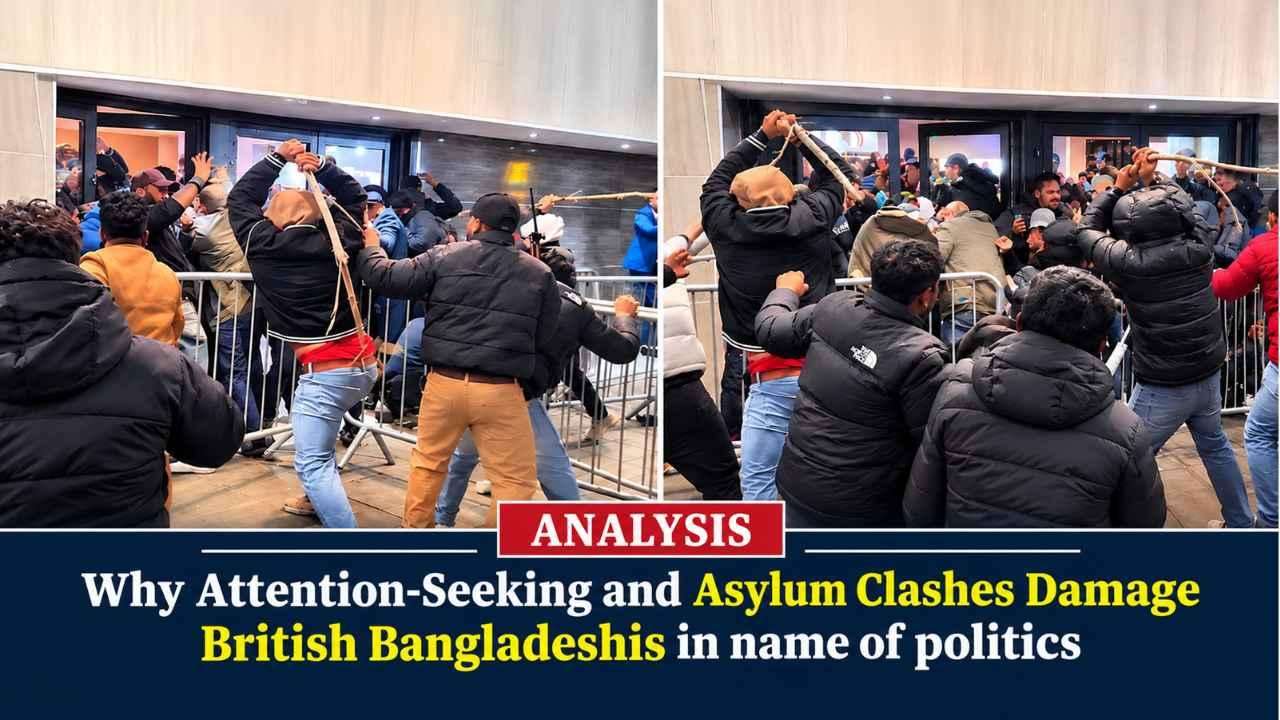
Physical street fighting erupted for twenty minutes on the road behind Mayfair Hall in Romford, east London, on Monday night, 16 November 2026, as activists of the Awami League and the National Citizen Party clashed after a reception for National Citizen Party Convener and Opposition Chief Whip Nahid Islam MP. Four people sustained severe head injuries and required hospital treatment, while Metropolitan Police officers carried out repeated baton charges to restore order. Daily Dazzling Dawn learned that local Awami League leaders and activists launched a prepared assault that caught National Citizen Party attendees off guard, following earlier protests around Nahid Islam’s 14 November appearance at the University of Cambridge. The confrontation has drawn sharp condemnation across the British Bangladeshi community and sharpened scrutiny over how attention-seeking factions, asylum-driven disorder, and unresolved domestic politics harm ordinary residents across the United Kingdom.
Community observers and attendees told to journalists that the disorder behind Mayfair Hall stemmed from staged provocation rather than genuine political debate. Daily Dazzling Dawn learned that demonstrators gathered outside the venue threw eggs and water bottles at arriving guests and assaulted attendees along the exterior perimeter, even though Nahid Islam had entered Mayfair Hall at 3:00 pm—more than three hours ahead of the scheduled evening start—and departed via a rear door without any face-to-face encounter. Daily Dazzling Dawn understands that community figures and critics point to a calculated immigration motive behind some of these confrontations. Several participants allegedly join or escalate street clashes to generate police reports, hospital records, and photographs as supporting evidence for UK asylum claims so they can argue they cannot safely return to Bangladesh. Attention-seeking theatrics and asylum-motivated street violence carry a heavy price for the wider British Bangladeshi community, turning public halls into flashpoints for partisan publicity while eroding credibility and public trust.
The immediate consequence of the Romford disorder has been rapid politicisation by far-right figures who treat a faction brawl as an indictment of an entire diaspora. Social media posts from Reform UK leader Nigel Farage described the clash as Bangladeshi mobs fighting on the streets of Romford over a foreign dispute and called for deporting foreign nationals who bring disorder to Britain. Former Reform UK MP Rupert Lowe similarly posted that Bangladeshi men were scrapping on Romford streets over a political dispute between the National Citizen Party and the Awami League, declaring that he did not care about Bangladesh and writing "Deport the lot". Daily Dazzling Dawn documented the wider public outrage in its coverage headlined "'Shameful': AL-NCP Street Fight in London Leaves Four Hospitalised After..." on 17 November 2026. When viral clips strip away context, families, shopkeepers, students, and professionals who have built quiet lives in London, Luton, Birmingham, and Oldham face collective suspicion in workplaces, schools, and neighbourhoods.
The deeper tragedy exposed by the Romford brawl lies in how far British Bangladeshi politics has drifted from constructive civic engagement. Anyone who makes their home in the United Kingdom has a responsibility to enter British mainstream politics, shaping local councils, public policy, and national representation through democratic institutions rather than staging street skirmishes over Dhaka’s party rivalries. Communities of Indian and Pakistani heritage have built substantial presence and influence in British mainstream politics at Westminster, holding parliamentary seats, ministerial posts, and national policy roles that advance their communities’ standing across Britain. By contrast, segments of the British Bangladeshi community remain locked in factional street fights in east London, turning a neighbourhood road in Romford into a spectacle of imported hostility. For British Bangladeshis, watching rival party activists trade blows in the street while peers in Westminster shape national law is profoundly shameful.
Diaspora residents and civic voices have voiced frustration that domestic rivalries from Dhaka continue to spill onto British streets. British Bangladeshi resident Farzana Boby Amie told to journalists that political differences can never justify violence, intimidation, or aggressive behaviour, describing the scenes as disgusting and deeply shameful. Cultural organiser Mahbubur Rahman Shiblu and other community members similarly emphasised that importing party hostility into Britain damages Bangladesh’s standing abroad and leaves British Bangladeshis carrying reputational scars they never chose. The episode also disrupted civic engagement during Nahid Islam’s week-long United Kingdom tour, which began on 13 November 2026 ahead of his scheduled return on 21 November 2026. Following the clash, Nahid Islam’s planned live television appearance on a local Bengali community channel was cancelled after a small group of Awami League activists gathered outside the station, while he visited injured attendees at King’s College Hospital in London. Ending Bangladeshi party politics on British soil and in other countries overseas is essential to protect the reputation of Bangladesh and its people and spare British Bangladeshis further public shame.
After years of eroding the country’s standing abroad in the name of domestic politics—escalating from egg-and-bottle throwing to blocking streets and trading blows—the entire community now faces lasting reputational damage. Ending this entrenched practice of political subservience to Bangladeshi party factions overseas is an urgent necessity.

.jpg)
.jpg)
.jpg)

.jpeg)
.jpg)