






.svg)
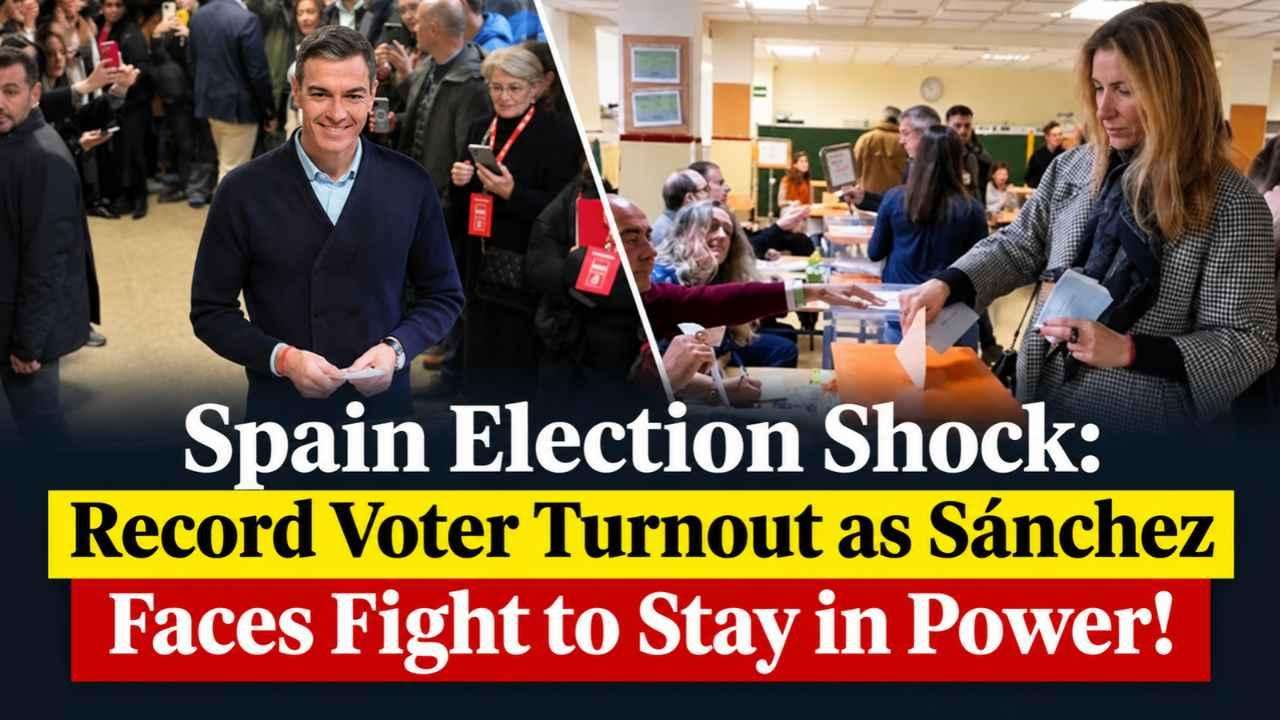
Millions of voters headed to polling stations across Spain on Sunday, 29 November 2026, as a snap general election put the country's Socialist-led government at risk of losing power after eight years in office. Preliminary figures from Spain's Interior Ministry showed that 45.7% of eligible voters had cast their ballots by 14:00 local time, marking the highest early afternoon turnout recorded in more than three decades. The election is being shaped by growing public anger over housing affordability, the rising cost of living, corruption and immigration, with conservative People's Party (PP) leader Alberto Núñez Feijóo seeking to replace incumbent Prime Minister Pedro Sánchez.
The election could also reshape Spain's political direction within the European Union, particularly if the PP requires support from the far-right Vox party to form a government. With nearly 39 million eligible voters participating, the result could have significant consequences for domestic housing policy, migration controls and Spain's position on European affairs.
According to preliminary figures released by Spain's Interior Ministry, 45.7% of eligible voters had participated by 14:00 on election day. This represented a notable increase compared with the 40.48% recorded at the same point during the 2023 general election.
The previous early afternoon turnout record was 41.8%, recorded in 1993.
The latest figures indicated that nearly 16.5 million people had already voted, suggesting strong public engagement with an election that could determine the country's political future.
Historically, higher turnout in Spain has often been associated with stronger participation among left-wing voters. However, political analysts caution that this relationship is no longer straightforward.
Daniel Cetrà, a political scientist at the University of Barcelona, explained that left-wing voters have traditionally been more susceptible to political disengagement. Nevertheless, Spain's increasingly fragmented political landscape means that higher participation could also benefit right-wing parties, including Vox.
Prime Minister Sánchez had repeatedly encouraged voters to participate, arguing during the campaign that turnout of 75% or more could favour the left.
Housing affordability has emerged as one of the defining issues of the election, following months of protests across Madrid, Barcelona, Valencia and other Spanish cities.
Public anger intensified after the eviction of Maricarmen Abascal, an 87-year-old woman who had lived in her Madrid apartment for more than 70 years.
In September, Abascal was forcibly removed from her home on a stretcher after being unable to afford a substantial rent increase. The property owner, Urbagestión, had purchased the apartment in 2018 and subsequently increased her monthly rent from €500 to €2,650.
The case attracted widespread attention and became a symbol of Spain's growing housing affordability problems, particularly for older residents and people on fixed incomes.
The company later offered to allow Abascal to return at a reduced rental rate. However, she was unable to sign an agreement after being admitted to hospital. She died on 7 October.
Her experience prompted demonstrations and renewed demands for stronger tenant protections, affordable accommodation and restrictions on excessive rent increases.
The political crisis intensified when Sánchez's Socialist-led coalition attempted to introduce emergency housing legislation on 2 October.
The proposed measures were intended to address mounting public concern about rental affordability and tenant protections. However, Spanish MPs rejected the legislation.
Two days later, following widespread protests, Sánchez called a snap general election approximately eight months ahead of schedule.
The decision effectively turned the housing dispute into a wider political contest over the direction of Spain's government.
For many younger voters, the housing crisis has become particularly difficult. Rising rents, limited affordable accommodation and stagnant wages have made independent living increasingly challenging.
Lily Nataxa, who participated in a protest encampment at Madrid's Puerta del Sol, described how her housing costs had changed over the past decade. She said that accommodation which once cost her €200 a month had become unaffordable, with her current rent reaching €900 for a small 30-square-metre apartment.
She argued that Spain needed more public housing, better rental protections and measures to prevent property speculation from making central Madrid inaccessible to ordinary residents.
The conservative People's Party, led by Alberto Núñez Feijóo, entered the election as a leading challenger to Sánchez's government.
However, opinion polling suggested that securing the support needed to govern could prove difficult without an agreement with Vox, led by Santiago Abascal.
Vox has taken a particularly hard line on immigration, advocating mass deportations and criticising the government's approach to migration.
The People's Party has also accused Sánchez of failing to manage immigration effectively, although its position focuses on greater controls rather than the more extensive measures demanded by Vox.
A PP-led coalition involving Vox could therefore represent a significant shift in Spain's domestic and European policies.
Politico reporter Aitor Hernández-Morales told the BBC that a conservative government could bring a notable change to Spain's approach to European affairs. He suggested that cooperation with Vox could also remove Spain's resistance to tougher EU migration policies.
Although immigration has featured prominently in political campaigning, housing, living costs, healthcare and working conditions have also ranked highly among voters' concerns.
The government has faced criticism over its decision to pursue the legalisation of unauthorised migrants, which attracted approximately 1.2 million applications this year.
The PP has called for more controlled immigration, while Vox has demanded large-scale deportations.
Recent arrivals in the Spanish territories of Ceuta and the Canary Islands have added to the debate. On 24 November, approximately 2,000 migrants arrived on the Canary Island of El Hierro, according to the figures reported during the election coverage.
The competing positions highlight the differences between the main political forces as voters consider the country's future direction.
Polling stations in mainland Spain are scheduled to close at 20:00 Central European Time (19:00 GMT) on Sunday.
The first preliminary election results are expected approximately one hour after voting closes.
Spain's Congress of Deputies has 350 seats. A political party or coalition needs an absolute majority of 176 seats to govern independently or through a parliamentary alliance.
Seats are allocated across 50 constituencies using a proportional representation system based on the D'Hondt method. This means that the final composition of parliament will depend not only on national vote shares but also on how parties perform in individual constituencies.
The outcome will determine whether Sánchez can retain power or whether Feijóo can assemble a new governing coalition with support from Vox.
As Spain awaits the final count, the unusually high early turnout underlines the significance of an election driven by concerns over housing, economic pressures and the country's political future.






.jpg)