




.svg)
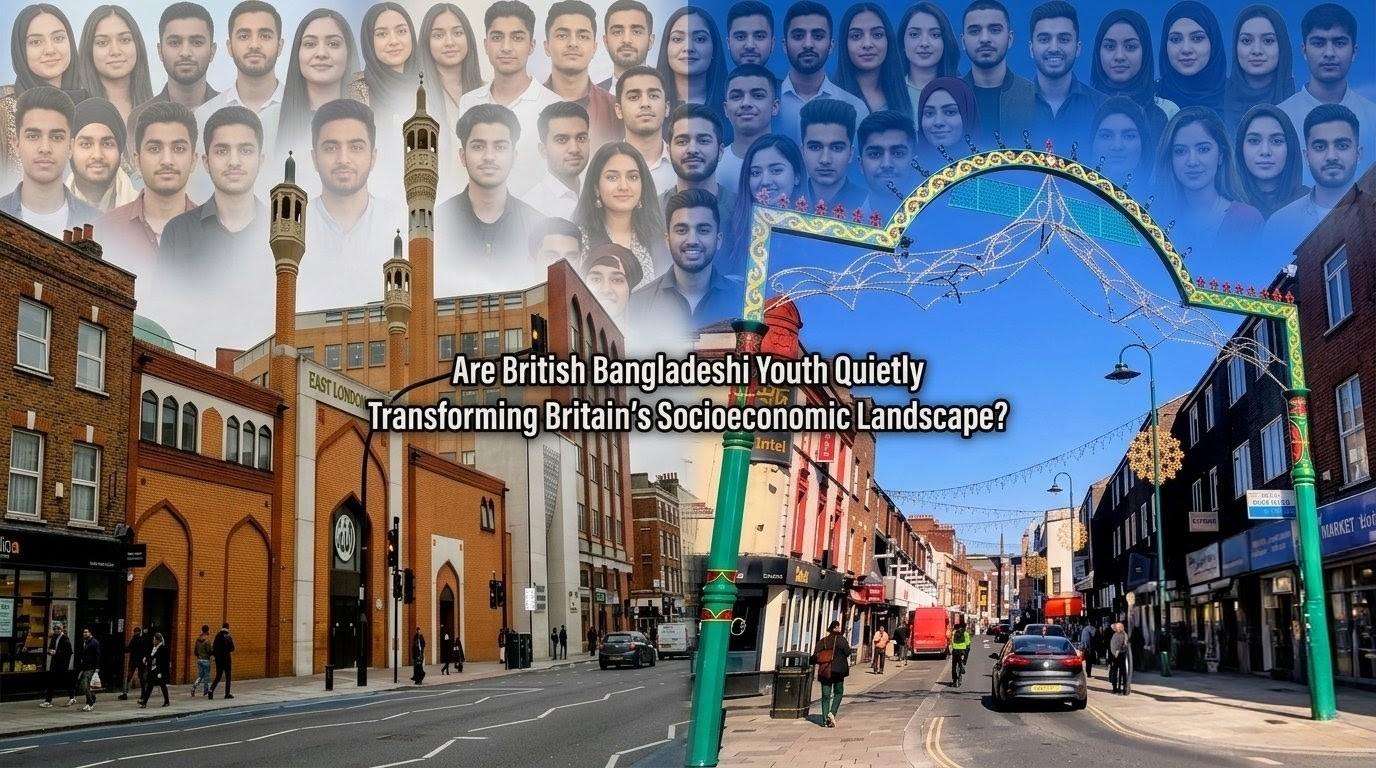
Young British Bangladeshis across England and Wales are driving an unprecedented educational and professional turnaround, fundamentally overturning decades of structural disadvantage and outperforming national benchmarks. Demographic analysis of official census data and educational registers confirms that while headline figures continue to highlight acute material poverty, the UK-born generation is advancing into elite universities and professional vocations at record speed. This dramatic transformation marks one of the most substantial social mobility shifts observed in modern British history, challenging long-standing perceptions surrounding immigrant economic integration.
The demographic group, which numbers roughly 650,000 individuals across England and Wales and is more than 90 per cent Muslim, historically confronted severe socio-economic distress. When the future King Charles III toured Spitalfields in East London in 1987, where thousands of migrant families had settled in the post-war decades, he remarked publicly that living conditions were unacceptable and almost comparable to the poorest regions of the subcontinent. Statutory assessments by the Commission for Racial Equality corroborated those concerns, documenting disproportionately high rates of chronic ill health and severe unemployment. Concurrently, a landmark 1985 government review recorded primary and secondary academic attainment among Bangladeshi pupils as exceptionally low, shaped by language barriers, initial rural displacement, low classroom expectations, and racial intimidation that constrained school choice.
Deep material disparities persist within broad national statistics, yet institutional researchers observe that these aggregate indicators mask rapid underlying progress. One in two Bangladeshi households still subsists in the lowest national income quintile after factoring in housing costs, whilst median household wealth remains below £100,000, in contrast to the £300,000 average observed across the wider British population. Because nearly half of the entire community was born abroad, constant inflows of first-generation arrivals dilute national metric averages, creating an outward appearance of economic inertia that obscures generational acceleration.
In secondary and higher education, the generational shift has proved comprehensive. During the early 2010s, Bangladeshi pupils caught up with the national GCSE pass rates achieved by white British peers, before pulling decisively ahead. Official tracking figures indicate that 67 per cent of Bangladeshi students who sat GCSE examinations in 2021 progressed to higher education by age 19, compared to only 38 per cent of white British school leavers. Course matriculation has increasingly pivoted towards high-yield technical and clinical disciplines: university enrollments in engineering and technology disciplines have doubled across the past decade, while placements in competitive medicine and dentistry degree courses have tripled.
Workplace dynamics illustrate a concurrent structural realignment, particularly among women. Historically depressed household revenues were rooted in exceptionally low rates of female economic participation, an obstacle that is disintegrating among the second and third generations. The 2021 Census revealed that 68 per cent of British-born Bangladeshi women aged 25 to 34 are now actively employed, moving within close reach of the 79 per cent recorded among white British counterparts. In stark contrast, only 32 per cent of immigrant women within that same demographic age bracket hold formal employment, illustrating the statistical divide between first-generation migrants and their UK-born descendants.
Professional managerial representation among British-born Bangladeshis aged 25 to 34 has climbed to 14 per cent, matching the national baseline for white Britons. In England's state school system, the number of registered Bangladeshi teachers has nearly tripled since the 2010 academic year. Speaking to Daily Dazzling Dawn, researchers noted that educational prowess has simultaneously reshaped social and cultural status, with qualified professionals increasingly commanding dynamic standing across community networks.
Geography and generational continuity explain why this integration trajectory differs from previous migration waves. While East African Asians arrived in a single concentrated influx during the 1970s and achieved swift commercial mobility, and Polish migrants rapidly integrated across regional job markets after 2004, the Bangladeshi demographic landscape continues to balance recent arrivals with established native citizens.
Commenting on the matter, journalist and author Mahbubul Karim Suyed told Daily Dazzling Dawn: "By conquering London’s dynamic economy and opportunities with their merit, British Bangladeshis are not only improving their own standard of living but are also bringing about a major positive transformation in the country’s overall socio-economic landscape."